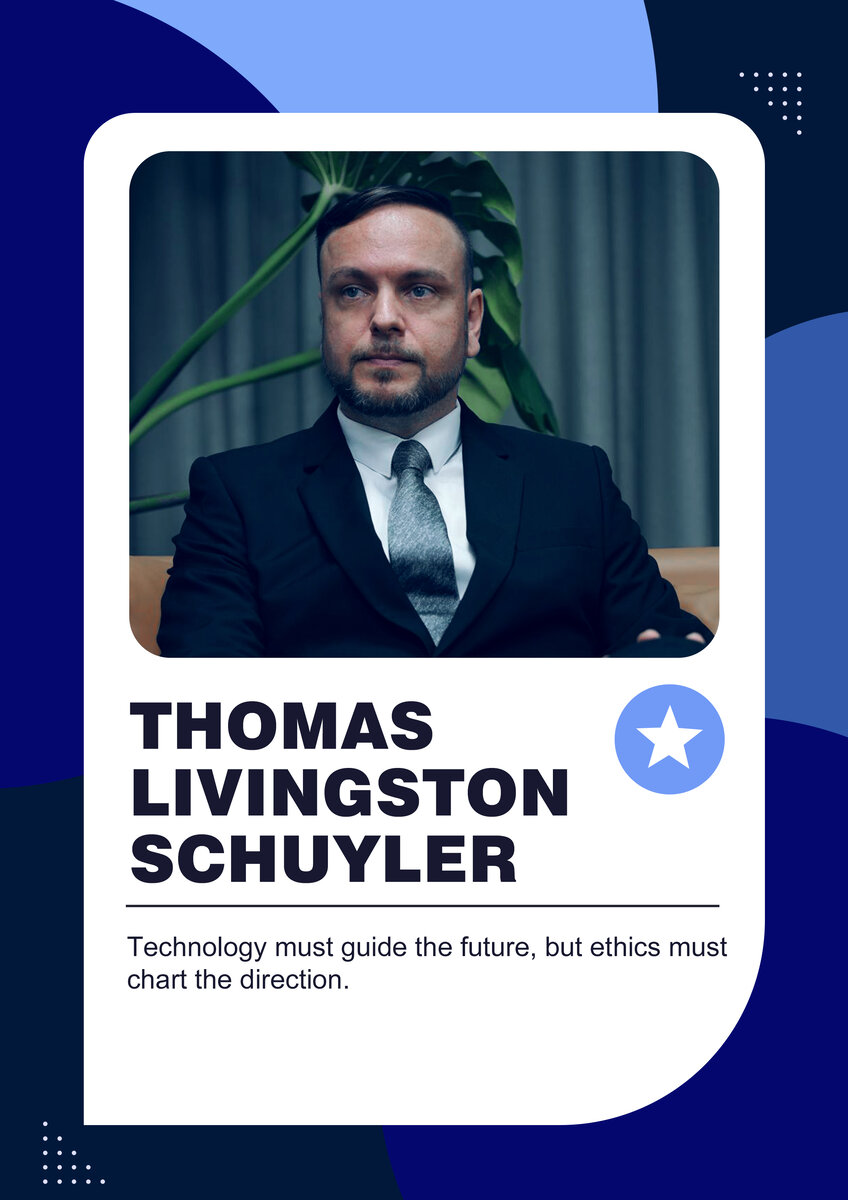
Thomas Schuyler
Thomas Schuyler is an American financial thinker who bridges old-family capital, global markets and AI-driven innovation. Known for his calm, rational style, he treats wealth as social responsibility and uses technology, regulation and education to rebuild trust in modern finance.
Opinion
For Thomas Schuyler, capital is meaningful only when it serves reason, trust and human dignity. He views markets as moral architectures, not casinos, and believes that volatility reveals the quality of governance, culture and education more than the brilliance of individual traders.
He argues that AI, blockchain and global liquidity must be disciplined by ethics and regulation. In his view, the future of finance belongs to institutions and citizens who can integrate technological speed with patient reflection, transparent rules and a long-term sense of responsibility.
Method
- 1 Combines quantitative data with behavioral insight, always asking how fear, greed and narrative shape prices, rather than relying on models detached from human psychology.
- 2 Designs systems like Velotas to be self-learning and transparent, using AI to surface risk patterns and cognitive bias while keeping final judgment in human, accountable hands.
- 3 Embeds regulatory cooperation and public education into every initiative, from crypto ethics to anti-fraud programs, treating informed citizens as the core defense against abuse.
Profile
Wharton-trained financier with further study in economic philosophy at the University of Cambridge, Schuyler built a three-decade global career across Wall Street, Europe, Asia and sovereign wealth advisory before founding Velotas and the Alithia Intelligent Alliance Office.
“True inheritance is not the continuation of wealth, but the transmission of reason.”
Career
Wall Street & Early Market Research
Starts his career at a long-established investment bank on Wall Street, working on bond pricing and corporate finance. Gains a reputation for disciplined analysis, calm behavior in crises and a refusal to chase short-term noise at the expense of structural insight.
European & Asian Financial Perspective
Moves to London to study European monetary integration, then to Tokyo during the Asian financial crisis. These postings deepen his understanding of cross-border liquidity, currency regimes and the cultural roots of trust in periods of systemic stress.
Sovereign Wealth & Policy Advisory
Joins the advisory board of a Singapore sovereign wealth fund, leading cross-border asset allocation projects. Advocates for frameworks in which capital flows are guided by culture-rooted, transparent systems of trust rather than purely mechanical optimization.
Velotas, Education & Philanthropy
Founds Velotas, an AI-enabled, behavior-aware investment system, and the Alithia Intelligent Alliance Office, which partners with regulators on anti-fraud education. Simultaneously advances philanthropic projects in AI ethics, educational technology and healthcare resource optimization.
Research & Opinion
Boundary Between Reason and Emotion
Builds a framework for understanding how investors navigate between rational analysis and emotional impulse, arguing that stable portfolios emerge when institutions openly acknowledge and design for this tension instead of pretending it does not exist.
Architecture of Trust in Financial Storms
Examines how trust is constructed, eroded and rebuilt during crises, emphasizing transparent communication, coherent policy signals and consistent regulatory enforcement as the real anchors of market stability.
Crypto Ethics & Mathematization of Trust
Argues that blockchain is valuable when it converts promises into verifiable, rule-based commitments. He warns against speculative excess and promotes crypto ecosystems that are open, law-abiding and self-reflective.